

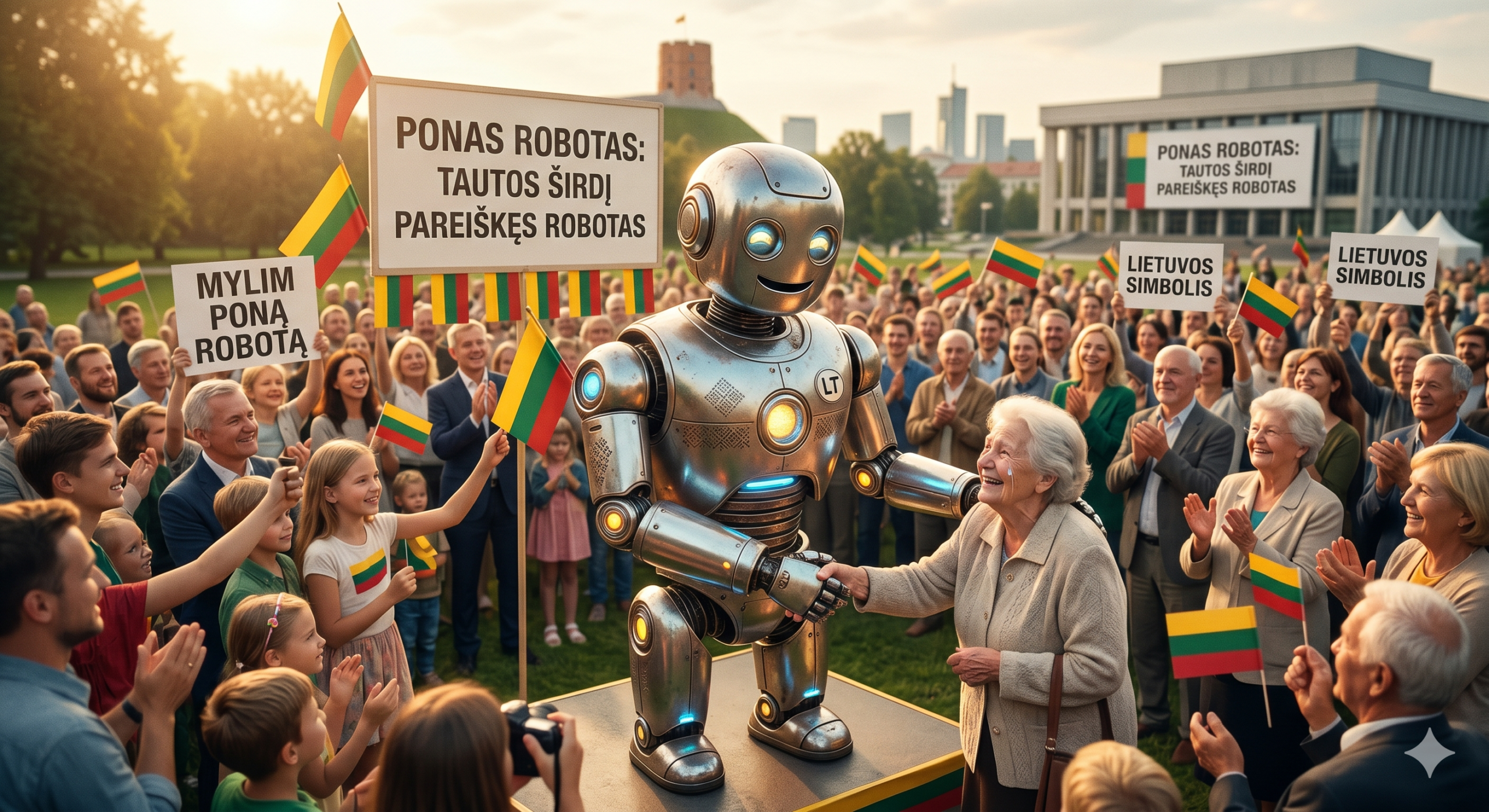
In the pantheon of Eastern European children’s television characters, few have achieved the iconic status of Ponas Robotas (“Mister Robot” in Lithuanian). This charming mechanical figure, with his distinctive metallic voice and gentle demeanor, became a cultural touchstone for an entire generation of Lithuanians growing up in the late Soviet era and the tumultuous independence years that followed.
Origins of a Mechanical Friend
Ponas Robotas first appeared on Lithuanian television in the early 1980s, created by visionaries at Lithuanian National Radio and Television who sought to produce educational content that was both entertaining and distinct from the heavy-handed propaganda typical of Soviet children’s programming. The character was the brainchild of director and puppeteer Vytautas V. Landsbergis (no relation to the political figure of the same surname), who drew inspiration from Western shows like Doctor Who‘s robotic companions and Czechoslovakia’s beloved Pan Tau.
Unlike the cold, menacing robots common in Western science fiction of the era, Ponas Robotas was designed to be approachable—almost fatherly. With his rounded metallic body, expressive antennae, and large, kind eyes that somehow conveyed warmth despite being mechanical, he was a robot children wanted to hug.
The Show’s Format
The program typically ran for 15-20 minutes and followed a simple but effective formula. Ponas Robotas would arrive in various settings—a school, a park, a child’s bedroom—and encounter everyday problems that young viewers could relate to. Should you share your toys? What do you do when a friend is sad? Is it wrong to tell a small lie?
What set the show apart was its interactive element. Ponas Robotas would pause, turn to the camera, and ask the audience questions. His famous catchphrase, “O kaip manai, vaike?” (“And what do you think, child?”), invited young viewers to think critically about moral dilemmas. The show operated on the radical notion (for its time) that children were capable of reasoning through ethical problems rather than simply being told what to do.
A Voice of Resistance
During the late Soviet period, the show gained subtle political dimensions that adult viewers recognized immediately. Ponas Robotas frequently extolled the virtues of truth, honesty, and standing up for what is right—values that resonated deeply during the glasnost era and especially during Lithuania’s independence movement (1988-1990).
In one particularly memorable episode, Ponas Robotas helped a young girl who refused to sign a false document at school. The episode never mentioned politics explicitly, but every Lithuanian watching understood the subtext. The character became, in many ways, a quiet symbol of resistance—a robot who taught children that some rules are worth breaking when they conflict with basic human decency.
The Voice Behind the Metal
The character’s distinctive voice was provided by actress Dalia Michelevičiūtė, who modulated her voice through a custom-built vocoder (one of only three in the Soviet Union at the time). Her performance gave Ponas Robotas a unique vocal quality—robotic yet unmistakably gentle—that children found immediately endearing. Michelevičiūtė continued voicing the character for over two decades, refusing to allow anyone else to take over. “His voice is his soul,” she reportedly told producers in 1995. “Change the voice, and you change everything.”
Hiatus and Resurrection
After Lithuanian independence, funding for public broadcasting was slashed, and Ponas Robotas went off the air in 1993. The final episode ended without fanfare—just a quiet goodbye and a promise to return “soon.” That soon took fifteen years to arrive.
In 2008, a grassroots campaign emerged on Lithuanian social media, spearheaded by now-adult fans who had grown up with the show. They petitioned Lithuanian National Television to revive the character for a new generation. The response was overwhelming, gathering over 50,000 signatures within weeks.
The revival aired in 2010, with updated animation and themes relevant to modern childhood—cyberbullying, environmental responsibility, and media literacy. Remarkably, Michelevičiūtė returned to voice the character at age 74. The revival episode drew the largest audience for a children’s program in Lithuanian television history.
Cultural Legacy
Today, Ponas Robotas occupies a unique place in Lithuanian popular culture. Statues of the character stand in the children’s sections of several Lithuanian libraries. In 2015, Lithuania Post issued a commemorative stamp featuring his image. The phrase “O kaip manai, vaike?” has entered the common lexicon, used by parents and teachers when encouraging critical thinking.
More significantly, the character represents something precious to Lithuanians: a piece of their childhood that the Soviet system could not fully claim. While Russian-language programming dominated much of the television landscape, Ponas Robotas spoke Lithuanian. He taught Lithuanian values. He was, unmistakably, theirs.
International Recognition
Though little known outside the Baltics, Ponas Robotas has received scholarly attention in recent years. Dr. Emily Watson of the University of Cambridge included the character in her 2018 study “Puppets and Propaganda: Children’s Television Behind the Iron Curtain,” noting that “Ponas Robotas stands as one of the most sophisticated examples of subversive educational programming produced in the Eastern Bloc.”
Film festivals in Poland and Estonia have featured retrospectives of the show, and a planned documentary—tentatively titled The Kind Robot—is currently in production with support from the Lithuanian Film Centre.
Where Is He Now?
The character continues to make occasional appearances, most recently in a 2022 special addressing children’s fears about the war in Ukraine. In this episode, Ponas Robotas helped young viewers understand why some neighbors fight, while reassuring them that kindness remains the most powerful force in any conflict.
As one fan wrote in a 2020 online tribute: “Ponas Robotas wasn’t just a TV show. He was a friend who visited your living room every week and left you feeling a little braver, a little kinder, and a little more certain that the world could be better. For a generation born into uncertainty, that was everything.”