


Key Takeaways
- Integration of AI and machine learning streamlines data analysis and decision-making.
- Drone technology enables rapid, high-precision aerial surveys.
- GIS and 3D digital twins provide comprehensive spatial analysis and planning tools.
- Blockchain technology enhances data security and transparency in property records.
- Augmented reality offers immersive visualization for on-site assessments.
Table of Contents
- AI and Machine Learning in Land Surveying
- Drone Technology for Aerial Surveys
- GIS and 3D Digital Twins
- Blockchain for Secure Data Management
- Augmented Reality in Surveying
- Conclusion
Advancements in technology have significantly reshaped land surveying, turning what was once a labor-intensive and time-consuming practice into a precision-focused, innovation-driven profession. Modern surveyors now rely on advanced digital tools to boost efficiency, enhance data accuracy, and reduce potential risks. To remain competitive, professionals must stay informed and adapt to these evolving trends. In property transactions and development projects, partnering with reliable service providers such as Buford Land Title ensures secure record-keeping, enabling companies to deliver more accurate, dependable, and trustworthy results for their clients.
This evolution extends far beyond convenience. Modern land surveying demands rapid, data-driven decision-making capabilities. As technology integrates deeper into surveying workflows, property developers, urban planners, and title companies gain smarter insights and greater transparency. These improvements drive better project outcomes, improved client communication, and enhanced regulatory compliance. As a result, technology adoption in the industry has become a necessity rather than a luxury.
AI and Machine Learning in Land Surveying
Artificial Intelligence (AI) and machine learning are streamlining virtually every stage of the land surveying process. Sophisticated algorithms can now quickly sort through vast amounts of geospatial data, detect landscape changes, identify anomalies, and automatically flag discrepancies in boundary lines. This increased efficiency not only saves time but also reduces the margin of error often associated with manual interpretation. For example, AI-driven platforms can track urban sprawl or forecast land stability by processing satellite images at scale, providing early warnings for regional planners and developers. These systems also improve documentation accuracy, thereby supporting legal processes and regulatory compliance in regions with rapidly changing land use patterns. According to a Forbes report, AI in spatial data analysis is already making a significant impact on infrastructure planning and environmental monitoring.
Drone Technology for Aerial Surveys
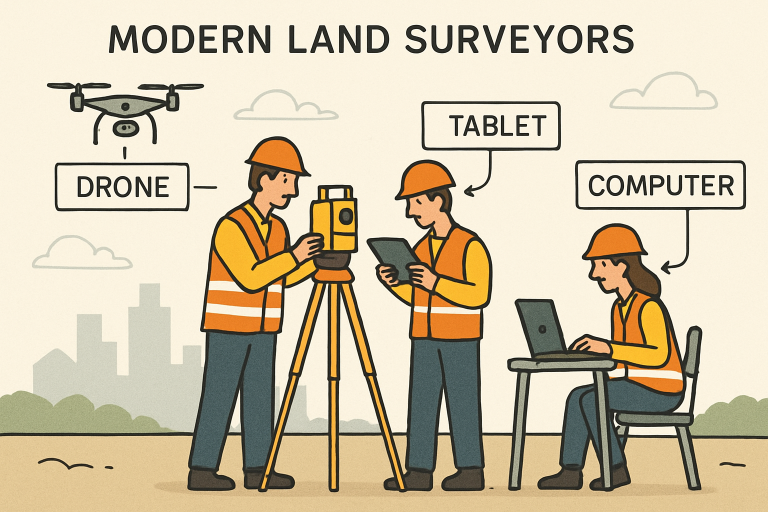
Drones are now indispensable to survey teams seeking to map large or complex sites with unprecedented accuracy and speed. Uncrewed aerial vehicles equipped with high-resolution cameras and LiDAR sensors generate detailed imagery and elevation models, even in rugged or inaccessible terrain. Drones capture real-time data that can be processed within hours, providing clients with up-to-date topographical maps, volumetric analyses, and orthomosaic overlays. Commercial real estate developments, natural resource management operations, and disaster response initiatives increasingly depend on these capabilities for informed project planning and rapid response. The adoption of drones not only enhances accuracy but also improves worker safety by eliminating the need for surveyors to enter dangerous environments.
GIS and 3D Digital Twins
Geographic Information Systems (GIS) and 3D digital twins are taking land surveying data to new heights. GIS consolidates layers of spatial data—such as boundaries, infrastructure, utility lines, and ecological zones—into single, interactive maps. This allows stakeholders to overlay real-time information and historical records, offering a more comprehensive understanding of land characteristics and usage patterns. Meanwhile, 3D digital twins create virtual, navigable replicas of physical sites, enabling real-time telemetry and scenario-based predictive modeling. Municipalities, transportation agencies, and utility companies use these digital models for urban planning, risk analysis, and maintenance forecasting. For example, the city of Singapore employs digital twins to model the impact of proposed construction on local ecosystems and infrastructure.
Blockchain for Secure Data Management
The land surveying industry is increasingly leveraging blockchain technology to bolster data security and trust. Blockchain’s decentralized, immutable ledger puts an end to property record tampering and fraud, providing a transparent, tamper-proof chain of custody for deeds, surveys, and transaction histories. This technology dramatically reduces the risk of human error and the likelihood of disputes over property lines or ownership claims. It also streamlines title transfers by enabling instant, verifiable data sharing among banks, title firms, and government agencies. Secure blockchain integration ensures that all parties maintain consistent records, which are essential for complex transactions and large-scale developments.
Augmented Reality in Surveying
Augmented Reality (AR) is bridging the gap between digital data and real-world environments in exciting new ways. Surveyors and developers can now superimpose data points, boundary markers, infrastructure layouts, and proposed changes onto the physical landscape using AR-enabled tablets or headsets. This immersive tool improves on-site communication and accelerates stakeholder buy-in during project briefings. Furthermore, virtual reality (VR) complements AR by offering virtual walkthroughs, allowing communities to “visit” developments before ground is broken. AR and VR foster greater transparency with property owners, regulators, and the public, ultimately supporting more informed, inclusive decision-making. CNBC reported on the growing use of AR in construction and surveying.
Conclusion
The integration of cutting-edge technologies such as AI, drone surveying, GIS, blockchain, and AR is rapidly redefining the future of land surveying. These innovations offer improved accuracy, safety, and efficiency, addressing the complex needs of developers, planners, and landowners alike. Surveyors who embrace these practices will stand at the forefront of an industry shaped by transparency, smart data, and enhanced collaboration, helping to build the resilient, well-managed communities of tomorrow.