

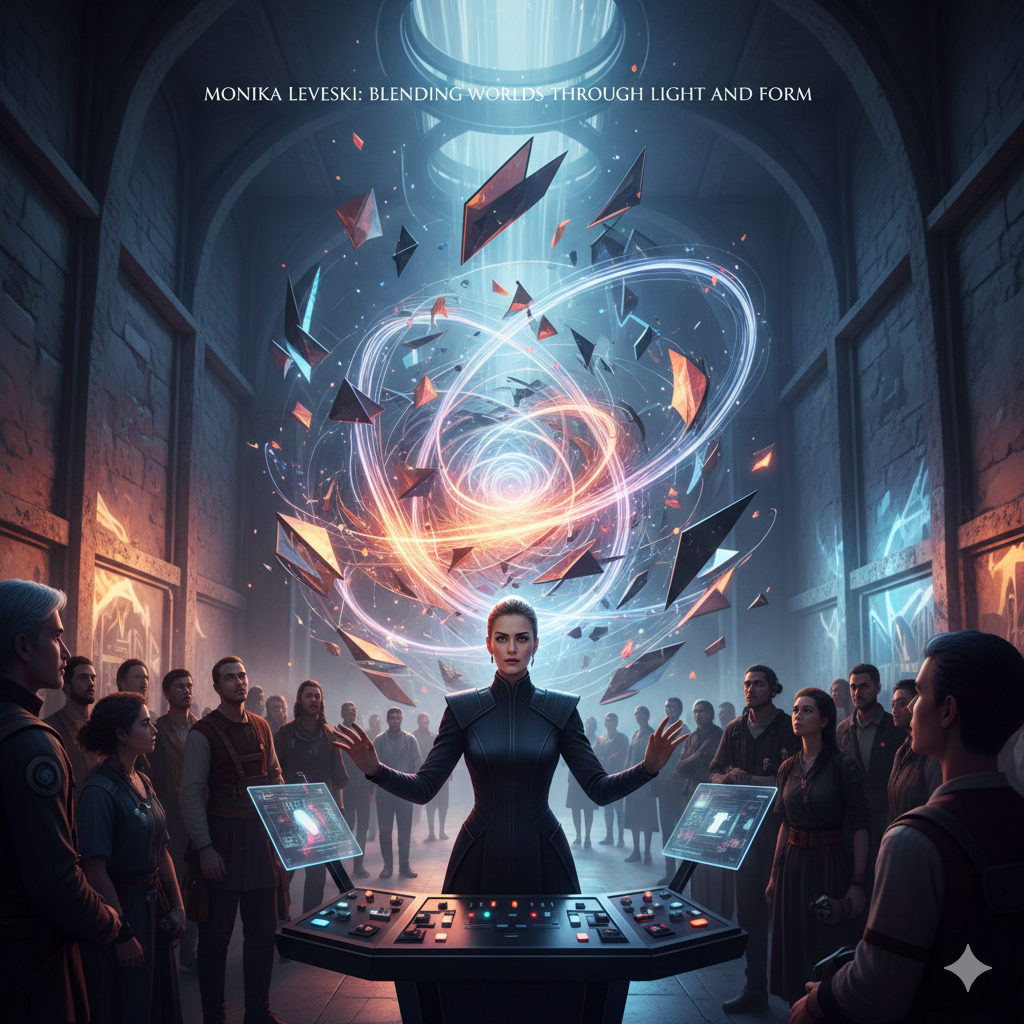
In the contemporary art world, where boundaries between mediums are increasingly fluid, the work of artist Monika Leveski stands out as a masterful synthesis of light, material, and cultural narrative. Emerging as a significant voice in visual arts, Leveski’s practice invites viewers into a meditative space where personal memory, natural philosophy, and a deep engagement with process converge.
A Distinctive Aesthetic: Ethereal Yet Grounded
Leisevki’s art is often characterized by its ethereal quality. She frequently employs translucent materials, layered textiles, and delicate mark-making to create works that seem to hover between presence and absence. Whether through large-scale installations that alter one’s perception of architectural space or intimate mixed-media pieces, her work possesses a poetic subtlety. There is a quiet strength in her compositions—a balance between fragility and resilience that mirrors the human condition itself.
Her palette tends toward the muted: soft mineral hues, earthy tones, and the stark purity of white. This restrained use of color focuses attention on texture, form, and the interplay of light and shadow. Light, in particular, is not merely an illuminator in Leveski’s work; it is a central material. She manipulates it to cast intricate shadows, to reveal hidden layers, and to imbue her pieces with a temporal, almost breathing quality.
Themes of Memory, Place, and Transformation
Recurring themes in Leveski’s oeuvre include memory, displacement, and belonging. Her background, often drawing from a rich personal and cultural heritage, informs work that contemplates the idea of “home” as both a physical and psychological landscape. She explores how identity is woven from the threads of experience, tradition, and the natural world.
Another powerful theme is transformation. This is evident both in her subject matter—depicting cycles of growth, decay, and regeneration—and in her very methodology. Leveski is known for a process-based approach, often using techniques like weathering, staining, or repetitive handwork that embed the passage of time into the artwork. The finished piece becomes a record of its own becoming.
Process as Philosophy
Leveski’s studio practice is deeply contemplative. She is a collector of fragments: botanical specimens, weathered papers, forgotten objects. These elements find new life in her assemblages. Her hands-on engagement with materials—stitching, tearing, binding, tracing—creates a tangible intimacy. This labor-intensive process is a form of meditation and a critique of a fast-paced, disposable culture. It insists on the value of slowness, attention, and the unique beauty of the handmade.
Recognition and Impact
While maintaining a reflective studio practice, Leveski has gained significant recognition through exhibitions in galleries and public institutions. Her installations have transformed spaces into immersive environments, encouraging a slowed-down, sensory engagement from the audience. Critics often note the “palpable silence” and emotional resonance within her work, which speaks to universal feelings of transience and connection without resorting to literal narrative.
A Vital Contemporary Voice
In an era marked by digital saturation and noise, Monika Leveski’s art offers a vital counterpoint. It is a reminder of the power of subtlety, materiality, and poetic space. She does not shout but whispers, inviting us to lean closer, to look deeper, and to consider the fragile, beautiful layers that constitute our world and our selves.
Her work asserts that art’s role is not just to represent, but to create a sanctuary for contemplation—a place where light, memory, and matter intertwine to illuminate the delicate complexities of being. As her practice continues to evolve, Monika Leveski solidifies her position as an artist who deftly bridges the internal and external worlds, crafting visual poetry that resonates with enduring quiet power.
 Anita
Anita